Player profile
Claudexor
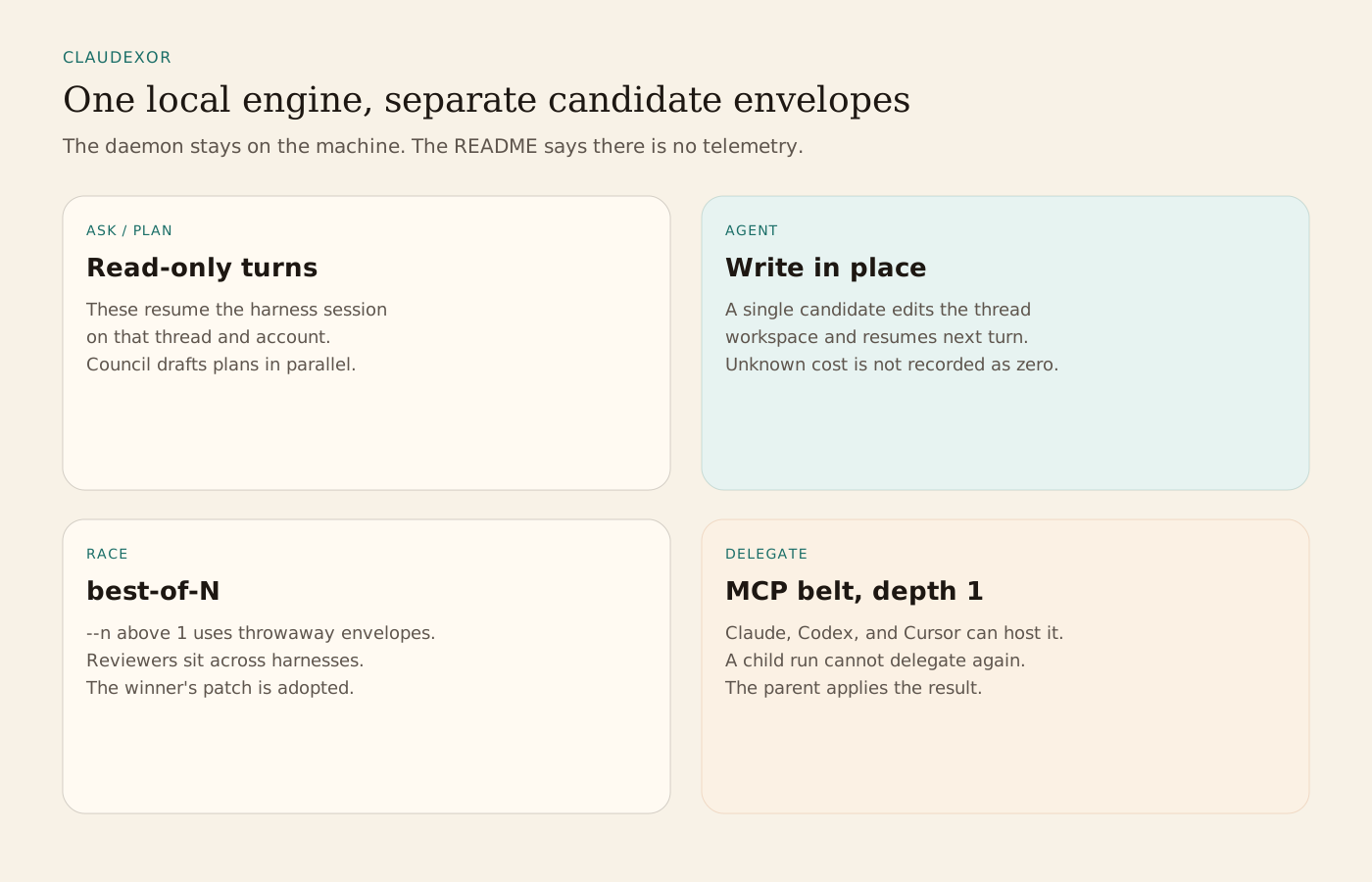
Claudexor is an MIT-licensed local control plane for coding CLIs already signed in on the machine. Ask and plan turns stay read-only. Agent turns write, and a best-of-N race keeps each candidate in its own envelope.
Profile
Where it fits
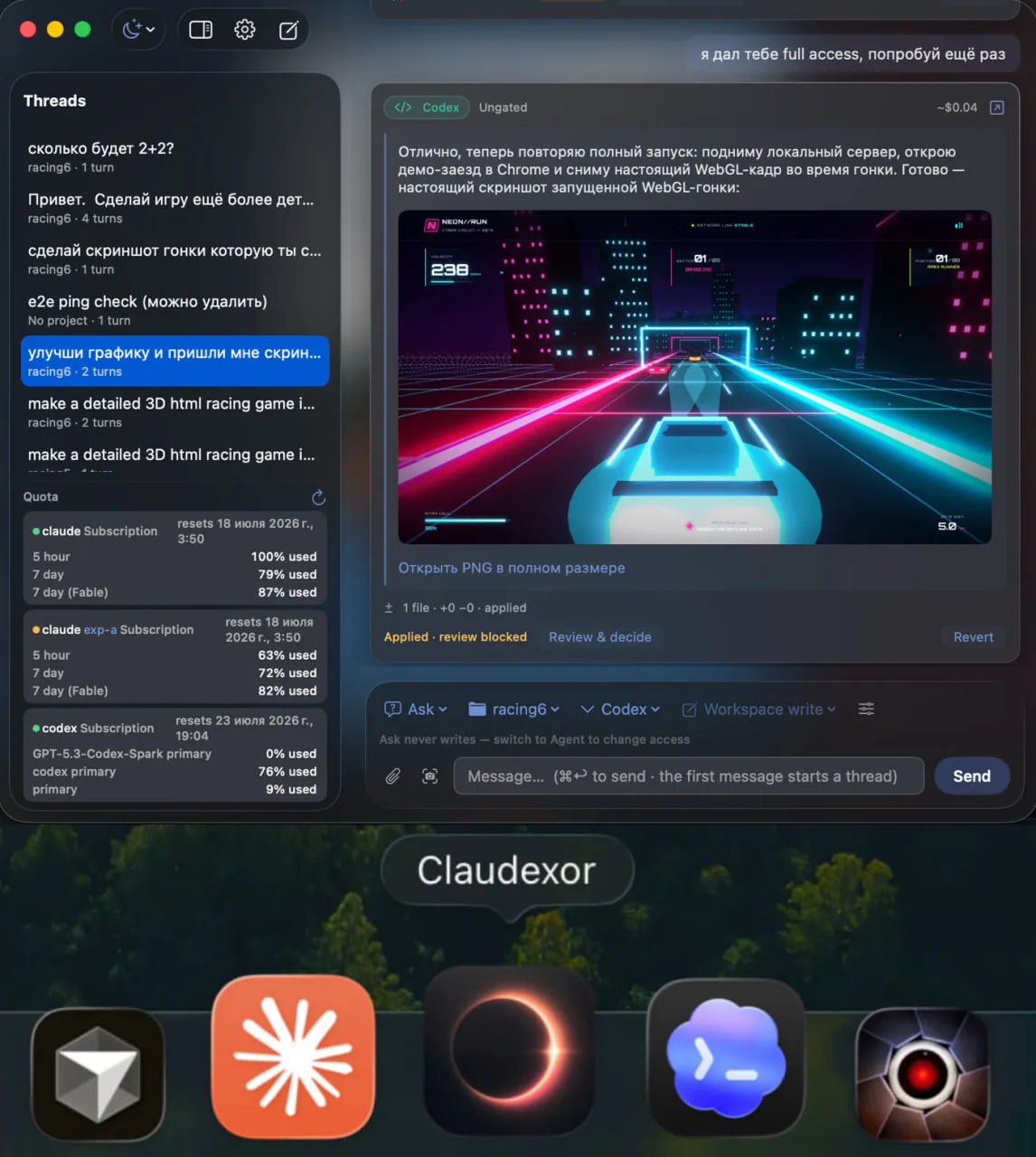
Claudexor runs Codex CLI, Claude Code, Cursor CLI, OpenCode, Antigravity CLI, Grok Build, and raw API adapters through one local engine. The Mac app is a signed and notarized DMG. It bundles its own Node runtime and starts the daemon on launch. The npm install -g claudexor path provides the claudexor and claudexord commands on macOS or Linux. The README says login and runs on Windows are not qualified yet. Git is required for worktrees. At least one vendor CLI has to be logged in through Claudexor, or a provider API key set for the raw API route. Files on the machine are the source of truth. The privacy section says Claudexor collects no telemetry, analytics, or crash reports.
The canonical modes are ask, plan, and agent. Ask is read-only. --deep-scan widens it into a bounded multi-scout pass with a synthesis. Plan is read-only and can freeze a plan as a content-hashed contract. --council drafts plans on several harnesses in parallel, writes each draft to a file, and has one member merge them into a single plan. A failed member is recorded and the merge continues with the drafts that remain. Agent is the writing route. A single candidate edits the thread's live tree and resumes the vendor's own session, so the next turn sees the work. --n above 1 runs a best-of-N race in isolated throwaway envelopes, reviews across harnesses, and adopts the winner's patch into the live tree. --attempts caps a repair loop. --until-clean keeps repairing until gates and review converge, the budget or quota runs out, the run is cancelled, or it stalls. Unknown cost is not stored as zero.
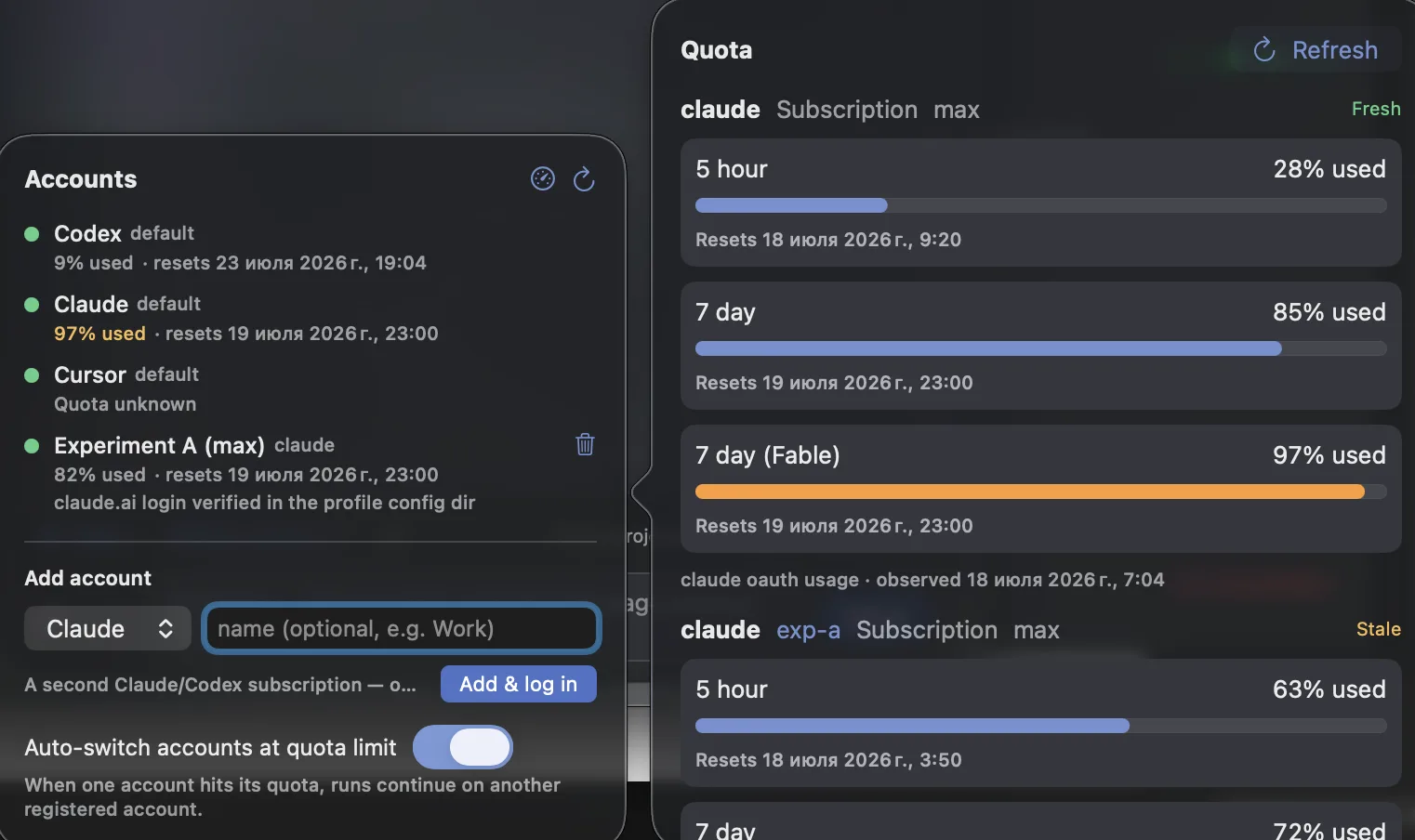
Named profiles hold Antigravity, Claude, Codex, Cursor, and Grok Build subscriptions side by side. Quota routing can move off an account when Antigravity, Claude, or Codex reports a typed limit. Cursor's dashboard supplies dated monetary figures, not an execution-quota verdict. A continuation packet fills a lane that missed part of the thread. The packet is a file, and the prompt points at that path. Switching harness or account does not migrate the vendor's native session.
--delegate injects a scoped MCP belt into Claude, Codex, or Cursor so the harness can start child runs. The belt exposes ask, plan, run, best-of, and status tools, not apply or settings. Depth is 1, so a child cannot delegate. The default cap is 8 children, on the parent's budget. The parent integrates the result. The control API listens on loopback with a bearer token. A remote SSH thread keeps the Mac UI local and the vendor CLIs on the host.
From the source
What the public materials show
Builder web analytics
Measure outcomes from Claudexor-assisted work
Claudexor records coding-agent execution and review. Separately configured analytics can help a team assess a deployed change's user-facing results.
This is an optional workflow, not a built-in Claudexor integration with Agent Analytics. Configure tracking on the deployed product and analytics access separately; Claudexor does not install tracking or send its run telemetry to Agent Analytics.
First loop to measure
- a team uses Claudexor to implement and review a product change
- the team deploys the change to a separately instrumented surface
- a human or an agent with separately configured analytics access reads the observed results
- the team uses that evidence when deciding on the next coding task
How to install Agent Analytics on Claudexor
If analytics access and tracking are already configured, inspect the deployed change's observation window and report measured user outcomes. Otherwise, explain what is missing. Do not imply a native Claudexor integration or infer causation from a before-and-after comparison alone.