T3 Code 0.1.0, published October 15, 2026 at 23:18 UTC, makes Orchestrator V2 stable. The MIT-licensed control plane now lets a parent agent use delegate_task to start child threads on another provider or model, continue working or wait, and receive their results.
That makes T3 Code relevant beyond running several coding sessions side by side. Its release notes document an MCP surface for creating, launching, messaging, waiting on and interrupting threads, plus worktree handoffs. Child threads retain their own provider-native histories, while lineage shows their model, status and results. Server-side queues retain their order across restarts and wait for the operator to resume them.
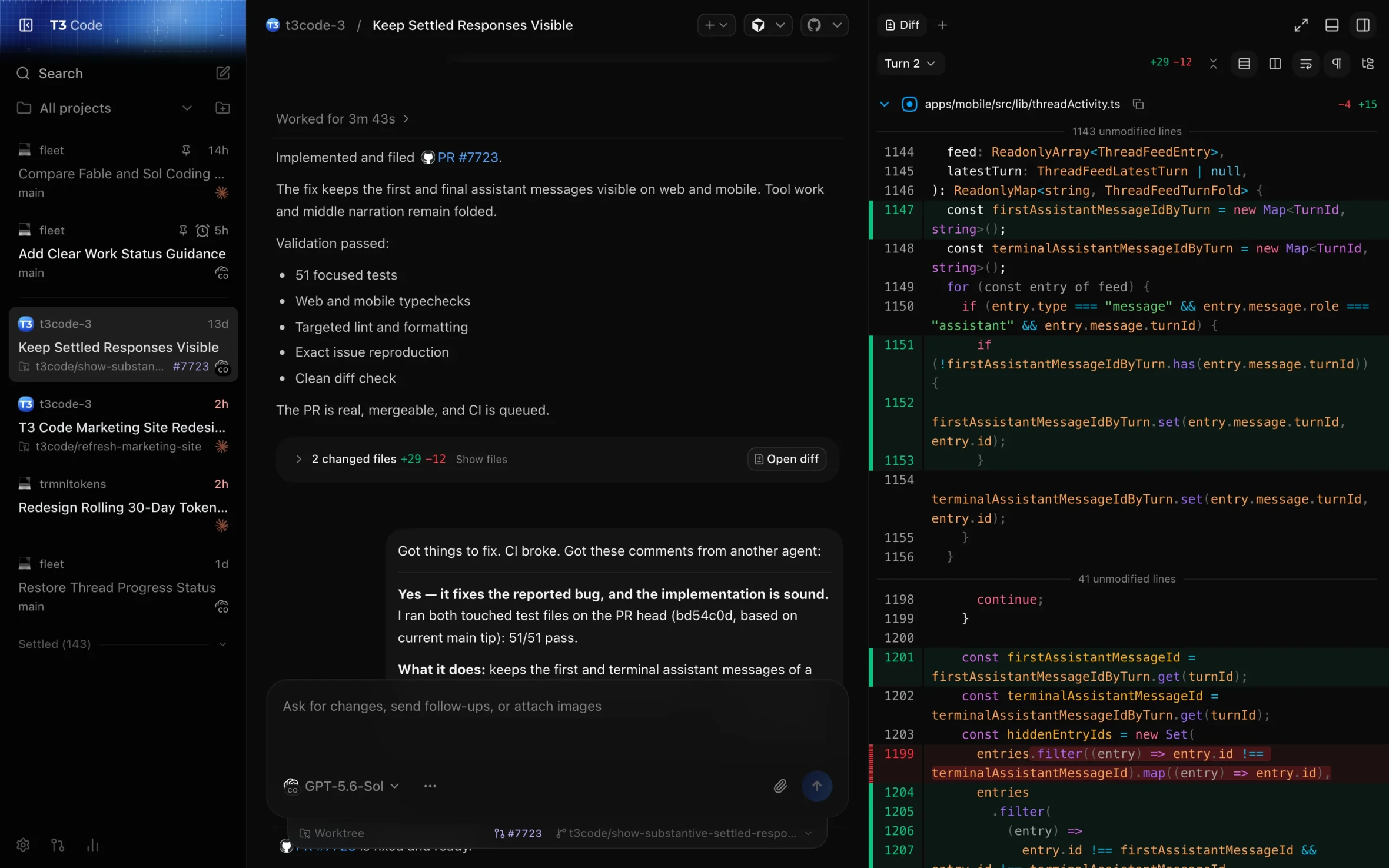
Product image supplied on the official T3 Code website, retrieved October 17, 2026; not a local test run or a demonstration of every V2 feature.
The attention is visible, but should stay in proportion. GitHub reported 28,030 stars and 7,503 forks on October 17. An October 17 comparison post on X discussing V2 had 174 likes, 32 replies and 19,328 views when checked. That is a useful discussion signal, not a benchmark, active-user count or 30-day growth rate. A September 30 Reddit thread also mentions T3 Code among third-party harnesses, but centers on subscription-access concerns rather than product adoption.
There are practical limits. Switching providers passes a budgeted selection of messages, omitting the prior provider’s reasoning, tool calls, results and attachments; the release recommends delegation for combining harnesses. V2 copies the V1 database once, and V1 clients cannot connect to a V2 server. Provider setup and charges remain separate. The permission guide says new threads initially default to Full access, so operators should choose their permission policy deliberately. The README still cautions that the project is early and bugs should be expected.
Provider apps and feature fit
T3 is a fit for consolidating coding-agent work; keep the provider apps for native workflows you depend on. Its Codex guide supports a ChatGPT plan or existing Codex login, while its Claude guide uses Claude Code’s login and configuration. OpenAI explicitly says plan sharing does not grant access to ChatGPT conversations or memories. No T3-specific support was verified for embedding or syncing a dot, or Space collaboration and permissions. T3 does document ChatGPT calling its environment through separately authorized MCP; that is a connection between systems.
T3 has sandboxed HTML replies and Codex-only MCP Apps rendering. Anthropic also supports Artifacts in Claude Code, but the complete artifact editing, publishing and synchronization workflow inside T3 was not verified. T3’s own schedules and supported-iOS voice transcription into a draft likewise do not establish native automation or real-time voice parity; its voice implementation explicitly lacks environment-backed transcription.
For Agent Analytics, the useful follow-up starts after the coding work ships. A T3 parent can delegate an onboarding change and its review; after deployment, a separately configured analytics task can verify signup_completed and first_project_created, then compare their observed counts and conversion with the prior period. Those events measure the product users receive. T3’s child-thread status, token usage and queue recovery remain orchestration telemetry. This is an optional workflow, with tracking and authorized analytics access configured separately; no native T3 Code–Agent Analytics integration was verified, and a before/after change alone does not establish causation.
Source confidence: High for documented release behavior, MIT license and upgrade limits; moderate for traction, which consists of cumulative repository counts and a small public-discussion sample. Runtime reliability was not tested in this pilot.
Evidence: